
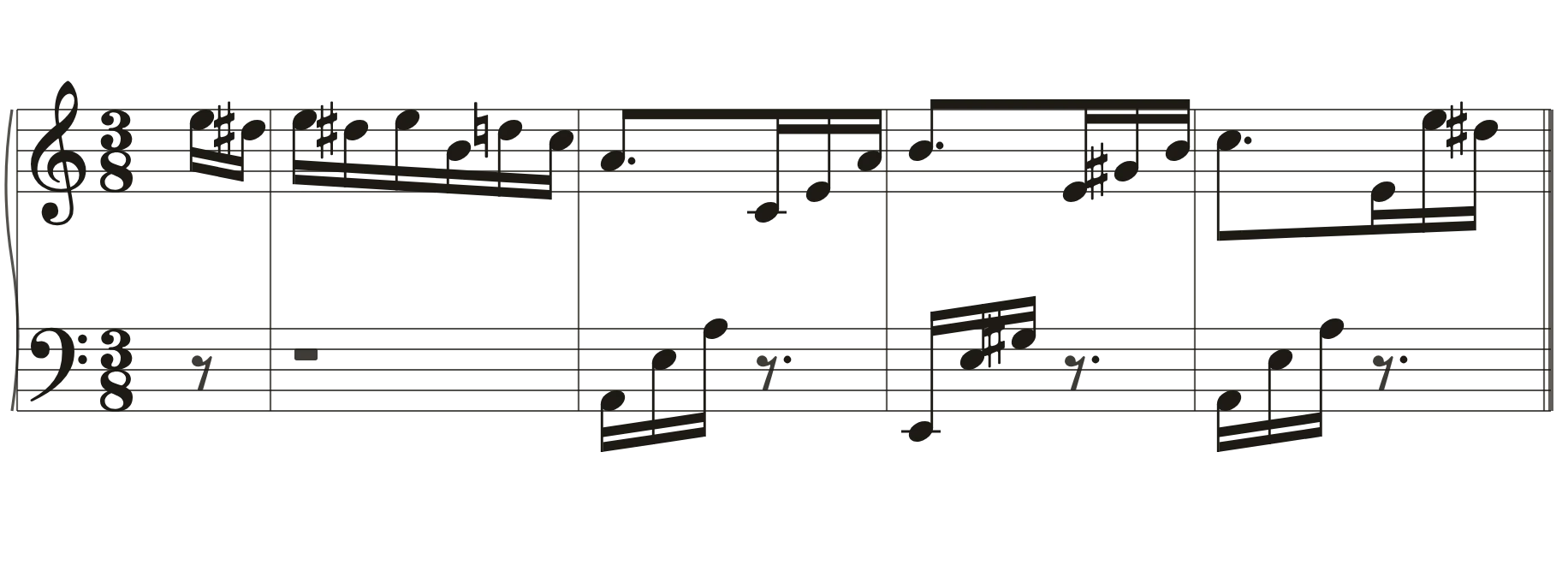
The rocking E-D♯ figure, broken A minor and E major chords, and the brighter C major episode. Counted in eighths.
The story
Beethoven never published this piece. It came to light in 1867, forty years after his death, when the scholar Ludwig Nohl printed it from a manuscript inscribed “Für Elise, 27 April, as a remembrance, from L. v. Bthvn”.
The manuscript has since been lost, and nobody knows who Elise was. The most popular theory is that Nohl misread “Therese”, for Therese Malfatti, a pupil Beethoven hoped to marry in 1810. Another candidate is the singer Elisabeth Röckel.
A bagatelle means “a trifle”, a small piece. Beethoven would surely be amazed that this trifle became perhaps the most famous piano piece ever written.
Three things to know
- The opening alternates two notes a semitone apart, E and D♯, like a sigh.
- Countless ice-cream trucks, phones and music boxes play its opening.
- The full piece has two stormier middle sections that most people never hear.
How to play it
Pass the melody smoothly between the hands: the left hand’s broken chords should feel like they continue the right hand’s line.