
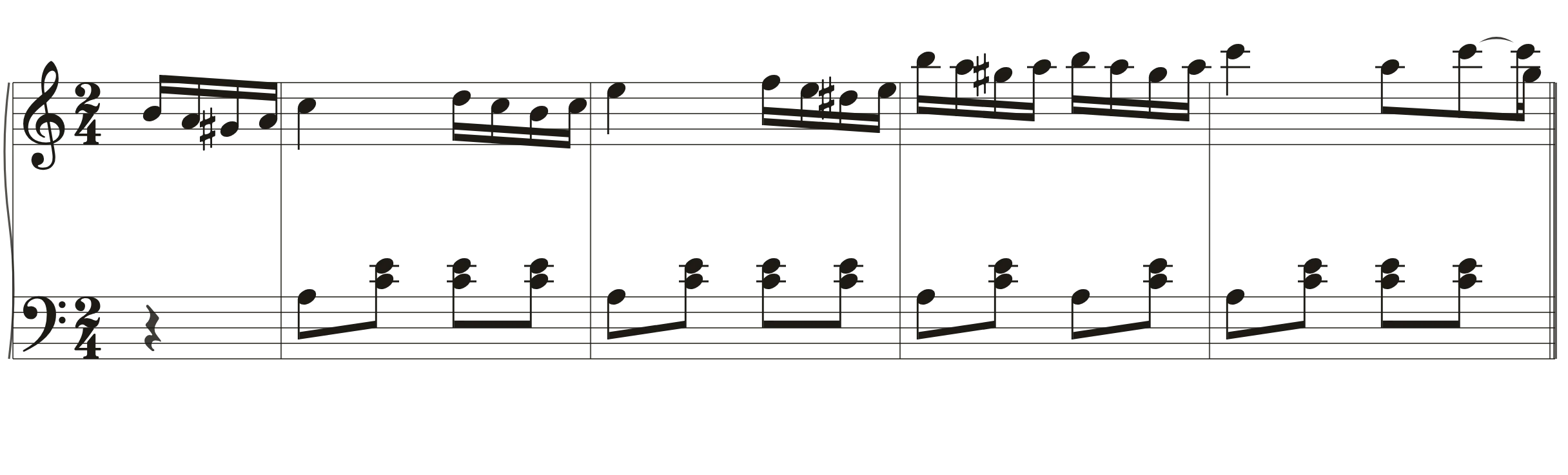
The finale of the Sonata K. 331, imitating a Turkish military band. Light, crisp sixteenths: keep the fingers close to the keys.
The story
Mozart wrote this sonata around 1783, and it was published in Vienna in 1784. Its last movement, marked “Alla turca” (in the Turkish style), became a sensation, and it still is.
Vienna had been besieged by the Ottoman army a century earlier, and Turkish military bands, the Janissaries, with their drums, cymbals and triangles, fascinated the city. Mozart imitates them, playfully and a little mockingly, with crashing chords and jangling left-hand rhythms.
In 2014 a librarian in Budapest found four lost pages of Mozart’s own handwritten score, which settled several old questions about which notes he really wrote.
Three things to know
- Some pianos of Mozart’s time had a “Janissary pedal” that rang a bell and thumped a drum inside the instrument.
- It is a rondo: the opening theme keeps coming back between contrasting sections.
- Mozart was 27 when he wrote it.
How to play it
The opening is all little turns around a note. Keep them light and even, as if the notes are spinning.